SHADE
Sign-in, accounts, permissions, an admin, an HTTP API, an audit log and plugins, for the small business that runs it.
- TypeScript
- Node
- Hono
- Nuxt 4
- Drizzle
- Postgres 18
- Valkey
- Docker
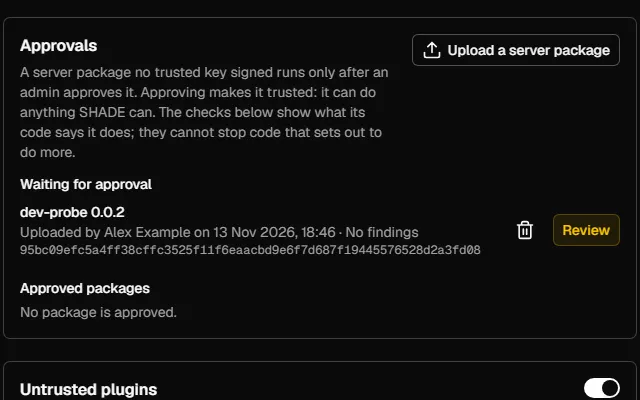
- Plugins: untrusted ones run in a sandbox, trusted ones are signed and approved by an admin.
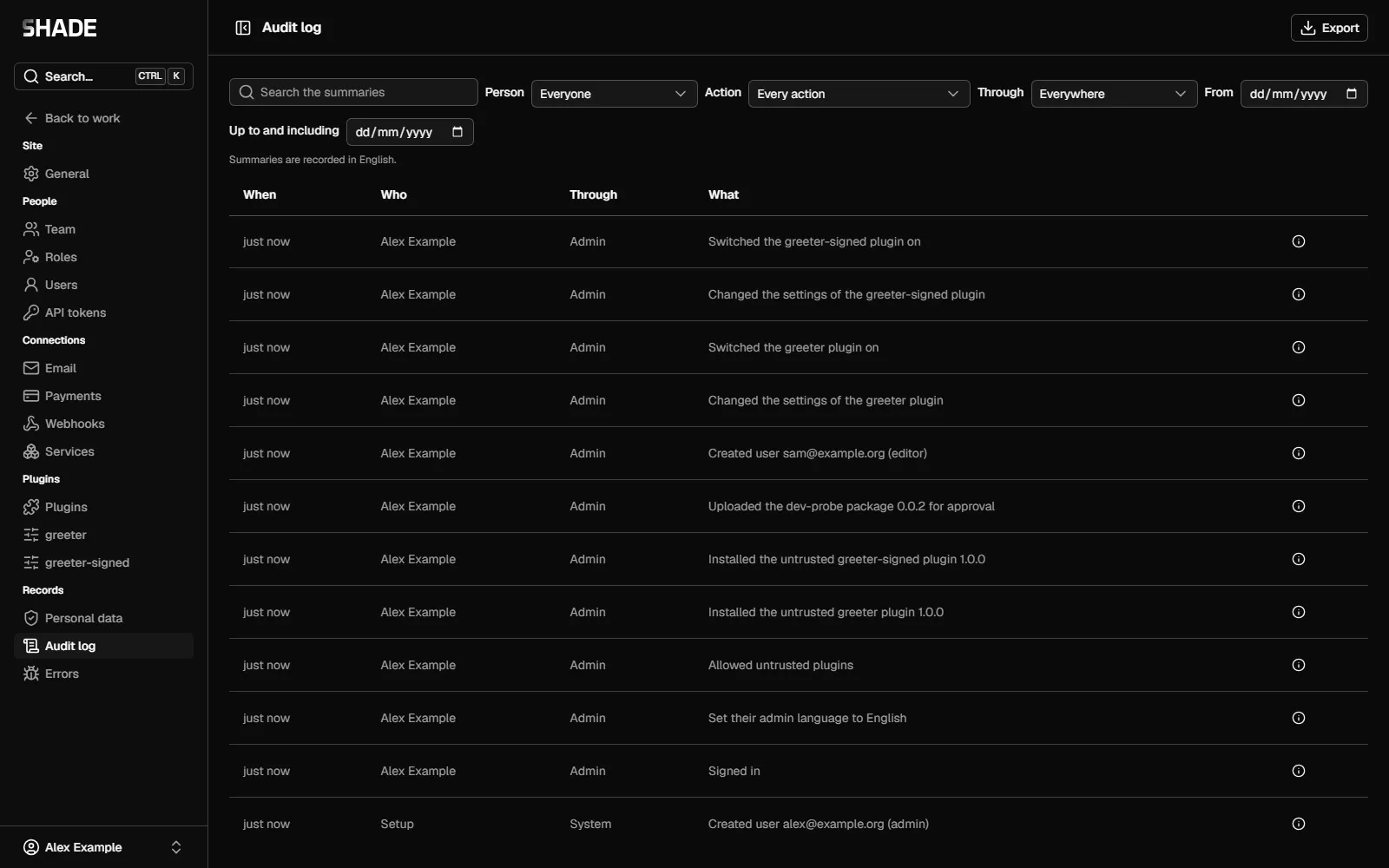
- The audit log: every change, and who made it.
Running plugins safely: untrusted plugins run in a workerd sandbox, and trusted ones must be signed and approved by an admin. Anyone can sign and install plugins on their own host; there is no key only RG Digital holds.
The problem
I built SHADE because of dashboards and CMSs. Each serves its own purpose, and each tends to grow past it. A dashboard starts as an internal screen for managing things and ends up as the API all data runs through. A CMS starts as the backend of a website, gets a webshop attached, and at some point can’t keep up.
SHADE (Self-Hosted Adaptive Data Engine) is open source software that a small business runs its own systems on. It brings the parts every one of them needs: sign-in, accounts, permissions, an admin, an HTTP API, an audit log and plugins. Each project adds the plugins it needs and its own frontend.
Next to those it has connections to outside services, and tools for data security and privacy. On top of that you build plugins. A plugin asks for the capabilities it needs and holds only those, so it can’t do more than an admin allowed. You write only the logic your application needs, not a whole application.
Constraints
One instance per business: one Docker image with Postgres 18 and Valkey. Nothing is shared between businesses.
The business owns its instance outright, with no licence keys. Anyone may host it, run it and change it. It’s self-hosted. RG Digital built it, and you’re never tied to it. For help with SHADE itself, go to the project.
It’s pre-release and licensed Apache-2.0. The repositories go public at the first stable release.
Decisions and why
Postgres is the only database of record. Valkey holds only work in flight, so losing it loses no data.
Plugins come in two kinds. Untrusted plugins run in a workerd sandbox; trusted ones must be signed and approved by an admin. Anyone can sign and install plugins on their own host.
Every decision is written down as a decision record.
What broke
Nothing broke outright. The pressure came from building it together with AI: every function, and every connection between functions, had to be secure and stay readable. So SHADE is split into six layers (kernel, foundation, content, publishing, management and entry), each handling only what belongs at its level. Parts use only lower layers, and an architecture test refuses any import that breaks that map.
How it was built
Claude Code implements features end to end. I review every pull request, make the product decisions and record them as decision records.